


By Peter Lund Frandsen
Can we understand what is actually happening during a treatment session?
Sometimes a client suddenly feels warmth, tingling, pulsation or movement somewhere in the body. At the same moment, the therapist may notice that the quality of the contact changes: the tissue softens, the resistance changes, the breathing deepens, or something simply feels different beneath the hands.
And there are even stranger experiences. You focus your attention or intention on a particular part of the client's body, without saying anything, and the client suddenly reports a sensation from that same area.

What is going on?
There are conventional physiological explanations for at least some of these experiences: changes in blood flow, autonomic activity, muscle tone, sensory processing and attention can all alter bodily sensation. But perhaps these observations also invite a broader question about energy and the living body.
Life is movement
Wherever there is life, there is energy in motion.
Electrical gradients are maintained across cell membranes. Ions move. Molecules are transported. Blood and lymph circulate. Muscles continually adjust their tension. Heat is produced and distributed. Mechanical forces travel through tissues. The nervous system is never completely silent.
Perhaps the important characteristic is not simply that energy exists, but that it changes.
A healthy organism is not a machine running at a perfectly constant level. It fluctuates. Heart rate changes from beat to beat. Breathing rises and falls. Blood vessels constrict and dilate. Muscles contract and release. Brain activity oscillates. Biological life seems to depend on variation - more like waves in an ocean than water standing still.
So what happens when something no longer moves freely?
Is "stuck energy" really energy waiting to move?
Holistic therapists often speak about blocked, stagnant or congested energy. These are useful experiential descriptions, but they are difficult to define scientifically. Perhaps another way of thinking about them is as stored potential.
Physics is full of situations in which energy is present without visibly moving.
A battery contains stored chemical potential that can produce an electrical current when a circuit is completed.
A rock resting high on a mountainside contains gravitational potential energy. It may remain there for a hundred years, apparently doing nothing. But if something releases it, the rock begins to fall and that stored potential becomes movement, deformation, sound and heat.
The nucleus of an atom contains enormous amounts of energy that, under particular circumstances, can be released and transformed into other forms.

Could this be a useful way to think about what therapists describe as congestion?
Not literally as a battery hidden inside a tense muscle, and not necessarily as a new form of physical energy. Rather, a region of the organism may be held in a relatively stable state: persistent muscular tension, altered fluid dynamics, restricted movement, sustained autonomic activation, sensitised neural circuits or habitual patterns of perception and protection.
The system has become too good at maintaining that state.
The therapeutic impulse
Then something happens.
A hand touches the foot. A joint is moved. A fascial structure is loaded differently. A nerve reflex point is stimulated. Breathing changes. Attention is directed toward an area. The client feels safe enough to release muscular guarding.
A relatively small input may sometimes produce a surprisingly large response.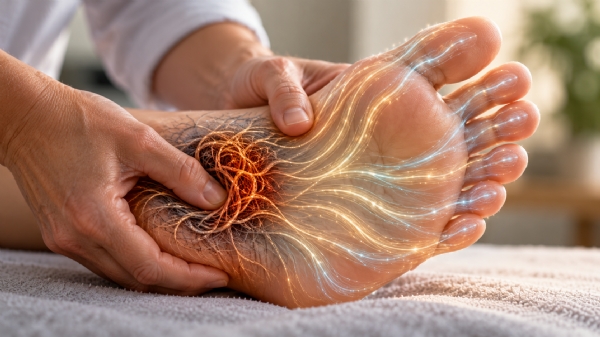
The interesting question may therefore not be: How much energy did the therapist put into the client?
Perhaps the better question is:
What did the therapeutic impulse allow the client's own system to do?
A therapist may not need to supply the energy responsible for the change. The organism already contains enormous energetic resources and continuously maintains electrical, chemical, mechanical and thermal gradients. The therapeutic stimulus might instead alter the conditions under which those resources are organised.
In that sense, treatment could sometimes be understood less as giving energy and more as changing the conditions for flow.
And perhaps that gives us a more interesting interpretation of those moments when warmth suddenly spreads, tingling appears, breathing changes or the quality beneath our fingers shifts.
Something that had been relatively stable has begun to change.
Something that was potential has become movement.
And whether we ultimately explain that through nerves, fascia, circulation, electromagnetic processes, attention, biofields - or mechanisms we do not yet understand - the clinical observation remains the same:
Living systems need movement. The therapeutic art may sometimes consist simply in helping something that has stopped moving to move again.
Explore the questions further
These are some of the questions we explore in the
The aim is not to replace physiology with an alternative explanation, or to pretend that we already have answers to these questions. It is to bring established science, emerging research, historical experiments and clinical experience into the same conversation - and to explore what concepts such as vibration, resonance, fields, information and subtle energy might add to our understanding of what happens between therapist and client.

Ryesgade 27
DK-2200 Copenhagen N
Denmark
Tel: (+45) 2575 7047
Email >